



Home » Geodetic Elements
Plano-altimetric determination of points
Geodetic and cartographic computation (geodetic computation between points, determination of points, measurement adjustments, deformation modules, etc.)
High-precision measurements for checking the stability of historical buildings and monitoring crustal and surface movements, etc.
Geodetic and geophysics measuring and computing (absolute positioning, magnetic north, gravity)
In 2009, IGMI updated the European Geodetic Reference ETRS89 to the realization ETRF2000, epoch 2008.0. The new frame was materialized by organizing a network of permanent GNSS stations on the national territory: the National Dynamic Network (Rete dinamica nazionale – RDN). This network system consists of 99 GNSS stations, mostly owned by Public Institutions, which transmit data acquired by satellite systems to a dedicated Data Center specifically set up within the IGMI Geodetic Department.
Locations of the RDN stations, and therefore the consequent definition of the reference frame, resulted by processing the data collected over the four-week period spanning January 1st, 2008. This processing was carried out by the Data Center following the EUREF guidelines (the IAG sub-commission for the European Reference System ETRS89) by using Bernese 5.0 software. Two other Data Centers, namely the G3 group of Milan directed by Prof. F. Sansò, and the Padua group of Prof. A. Caporali, repeated independently the same calculations for an additional control. Final results are shown in the technical report describing, in detail, the development of the RDN installation project.
Since RDN establishment, IGMI has continued to collect data transmitted by the stations and distributes them to users through free access, to the data center of the Geodetic Department
The RDN network is continuously monitored by the Geodetic Department’s Data Center to ensure the quality and availability of data transmitted by the stations. Due to various disruptions, some RDN stations belonging to the original network are no longer active. The Geodetic Department has therefore introduced new sites, restoring the network to a total of approximately 140 stations, in order to preserve a uniform coverage of the national territory. The new network is called RDN2 and the new stations’ data are available in a separate archive at the data center.
The Data Center processes data from the RDN2 network on a weekly basis using Bernese 5.2 software. The results are integrated into the current frame of the International Geodetic System (IGS) and published in ASCII and SINEX format, in a dedicated section, organized according to GPS weeks. Moreover, during 2017, the Data Center reprocessed the entire time series of the weekly solutions, obtaining an aggregate solutions for the positions as well as for the speeds of the RDN network sites. Position and speed estimates, along with the relevant technical documentation, are published in the data center of the Geodetic Department.
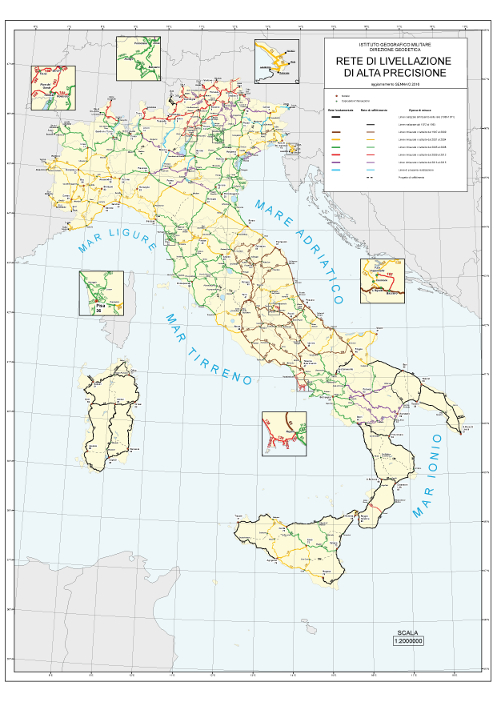
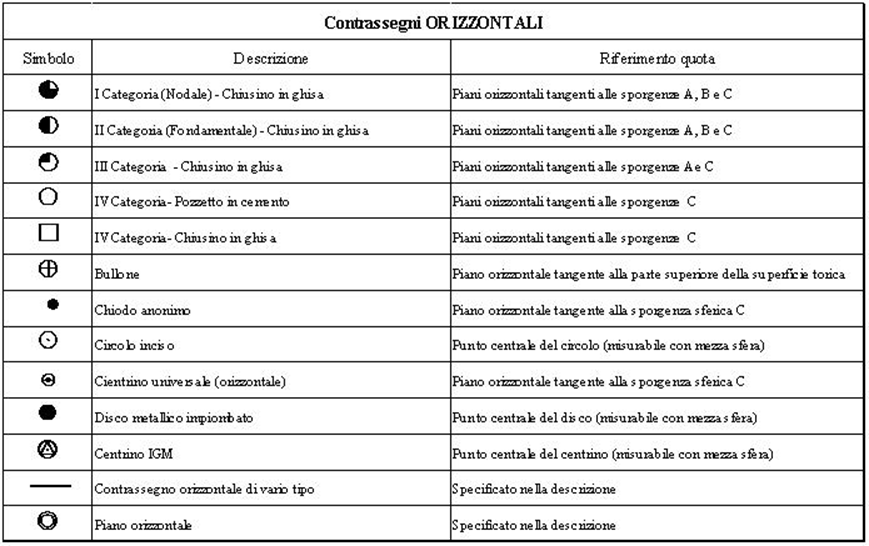
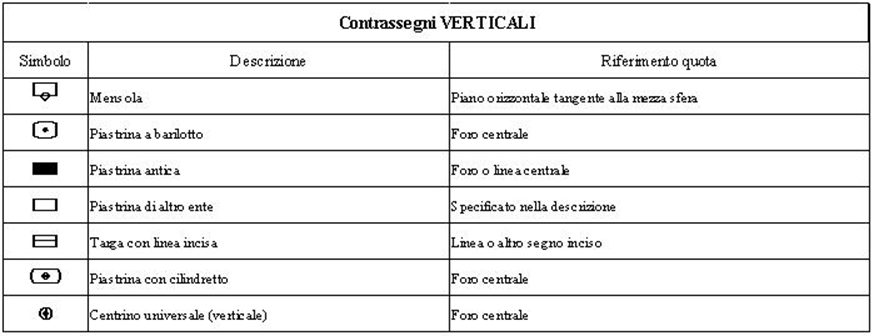
In the geographic search engine, leveling benchmarks are indicated by red or blue round icons. These different symbols are described below:
Leveling benchmark measured after 1996
leveling benchmark
Monograph of benchmarks consists of a pdf sheet of useful information that will be send to the costumer.
In each information sheet are indicated:
The following monographs are available:
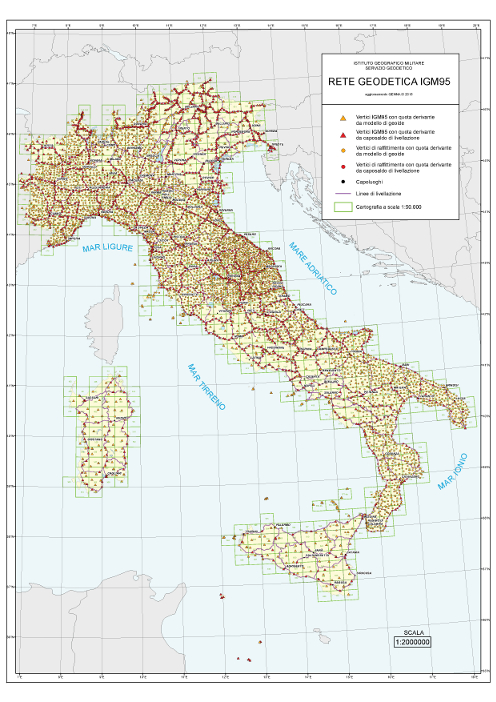
In the geographic search engine, IGM95 points are represented by red or blue triangles and squares. These different symbols are described below:
IGM95 with height established by leveling
IGM95
second order vertex with height established by leveling
second order vertex
Monographs of IGM95 points are for sale. The associated point, when existing, is for sale with the main one at the same price. Monograph of IGM95 points consists of a sheet of useful information concerning the point.
In each information sheet are indicated:
The following monographs are available:
The fundamental trigonometric network, carried out by triangulation and trilateration, consists of more than 20,000 trigonometric vertexes divided into 4 orders and uniformly distributed over the national territory with an interdistance of about 5 km. It covers uniformly all Italy and was first set up between the Italian unification (1861) and 1919. Other national networks such as the Cadastral one are derived from it. This network has an accuracy of a few decimeters in both planimetry and elevation.
In the geographic search engine, trig-points are represented by red or blue squares. These different symbols are described below:
trig-point
Trigonometric vertex of uncertain definition
Monograph of trig-points vertexes consists of a sheet of useful information concerning the point. In each information sheet are indicated:
The following monographs are available:
In the Historical Archives of the Geodetic Department is stored the documentation concerning geodetic works from the mid-nineteenth century to the present. The documentation is mainly related to works carried out on Italian territory, but data on former Italian colonies across the sea can also be found.
The following documents can be requested:
Verto family software enables coordinate conversions between the most widely used reference systems in Italy: Rome40, ED50 and ETRS89, the latter in the ETRF89 and ETRF2000 realizations.
List if software currently available:
MAIN DIFFERENCES