icona-ricerca_bg
icona-accedi-registrati_bg

Area riservata/Registrati

icona-lingua-ITA

It

Si informano i gentili utenti che, al momento, l’acquisto dei prodotti IGM è effettuabile esclusivamente tramite il sito ufficiale www.igmi.org
Il servizio di vendita diretta su questa piattaforma è in fase di implementazione e sarà reso disponibile prossimamente. Ci scusiamo per il temporaneo disagio.

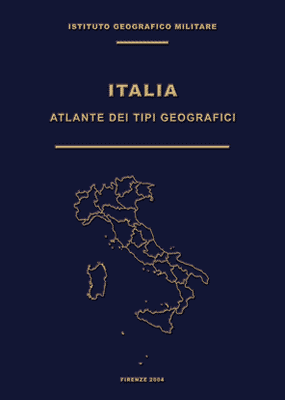
See Italy Atlas of Geographic Types

Under the high patronage of the President of the Republic

See the Atlas

WARNING
For detailed information of the contents given in these pages, the original edition in the possession of the Editor of the work shall always prevail. Reproduction of the texts in electronic format on the site is permitted, unless otherwise expressly authorized, exclusively for personal and non-commercial use provided that the source is mentioned and the form and/or contents are not altered in any way. In any case, this is without prejudice to the Administration’s ability to protect itself in the appropriate venues for any recognized violation of the provisions in force and, in particular, of the rules placed to protect intellectual property.

PRESENTATION

The Italian Military Geographic Institute and the Cassa di Risparmio di Firenze
are pleased to announce to the country the publication of the volume
Italy. Atlas of geographical types. ,
expanded and updated edition of the famous work of the same name, compiled by Olinto Marinelli in 1922 and which had a single reissue in the now distant 1948: a fundamental and irreplaceable tool for the training of the generations of Italian geographers who since the interwar period have taken turns on the academic and professional scene. The new atlas, while following in the footsteps of its predecessor, is a new work, with profoundly renewed content, methodological approach and editorial form; and its realization is a concrete testimony to the role that the Istituto Geografico Militare plays in the dissemination of geographical culture and the use of cartography and related tools, for the study and government of the territory. By collaborating to carry out this work, the Institute and the Cassa di Risparmio di Firenze bank wanted to offer, to the scientific community and to those who work in the field of geographic sciences and territorial studies, a basic tool for training, which will be a sure reference to face in the most conscious way the ever-growing needs connected with the management of resources, land planning and environmental protection, in a scenario in which calamitous events and hydrogeological disruptions of both natural and anthropic origin are increasingly frequent.

The work is set in the dynamic scenario of our days, where geographic disciplines play an important and irreplaceable role; a scenario quite different from that of the 1920s, almost a century has now passed marked by tormented historical events, which have profoundly affected the features of a large part of the national territory. However, it is not only the features that have undergone changes: the disciplinary field of geographic sciences has witnessed the constant updating of methodological foundations, brought over the decades by the impetus of scientific and technological progress.

For this reason, in the realization of the present volume, never was the aim pursued to offer the learner and the user a mere editorial expansion and a concomitant update of the previous editions, although the assumption remained firm at the time of arriving at a work that does not replace specialized manuals, as a tool aimed at the teaching of geography in the broadest sense. A teaching support, it is hoped, that will be used not only by universities and secondary schools, but also by the varied users of the many research centers and public and private institutions operating in our country.

The iconographic collection of Atlas of geographic(al) types. , aimed at illustrating the multiple and multiform geographic types found in the national territory, is vast; and the tool that has been most widely used in the visual explication of these types is undoubtedly the cartographic one: of the approximately two thousand illustrations presented, more than half are taken from documentation produced by the Institute (cartography at various scales and aerial photographs); the remainder from pre-Unitarian historical maps, regional technical maps, geological maps, cadastral maps, nautical maps, thematic maps, satellite images, cartograms, graphs, and orographic sections.

For this work, the Italian Military Geographic Institute and the Cassa di Risparmio di Firenze, have made available their financial, organizational, editorial, and scientific resources, and have called upon the national academic world, extending the request for collaboration to the relevant institutions (Hydrographic Institute of the Navy, General Office for Meteorology of the Air Force, Central Directorate of Cartography, Cadastre and Real Estate Publicity, Geological Service of Italy, National Research Council). This invitation, accepted with general enthusiasm by the world of geographers belonging to as many as thirty-nine Italian universities, has involved a vast scientific effort, to which credit is certainly due for having achieved such a significant milestone for the entire disciplinary field.

Il Presidente dell´Ente Cassa di Risparmio di Firenze,
Cav. del lavoro Alberto Carmi

L´Ispettore Logistico dell’Esercito,
Ten. Gen. Michele Corrado

In the autumn of 2002, the Italian Military Geographic Institute, on the occasion of the 130th anniversary of its establishment, and the Cassa di Risparmio di Firenze presented the reprint of the Atlas of Geographical Types compiled in 1922 by Olinto Marinelli, with the intention of operating a new and wider dissemination of Marinelli´s monumental volume, and announced, following numerous requests from Italian geographers, the creation of a new atlas, inspired by the memory of its first compiler, updated, expanded and revised in content and form. Today the Italian Military Geographic Institute, thanks to the joint efforts made with the Cassa di Risparmio di Firenze, and to the wide collaboration of the academic world, research and institutions engaged in the field of subjects related to the territory, brings to completion a publishing project of great importance with the publication of the work
Italy. Atlas of geographic(al) types,
thereby corresponding to the repeated wishes expressed by the scientific community of Italian geographers in recent decades. The volume, which comes eighty-two years after the first edition of the Atlas, proposes itself as a radical update and expansion of the same, in the light of all those transformations that in that timeframe have greatly altered the face of the national territory, have registered new achievements and profound changes in the field of geotopocartographic studies and have seen a radical change in the very scientific paradigms of geography. In this sense, after a brief overview of a propaedeutic nature on the main tools for geographic analysis, aimed at integrating the content of the tables, the Atlas punctually addresses the canonical themes of both physical and human geography, making its own the assumption that “from science comes wisdom, which turns to the good of all things,” placed back in 1595 by Gerardo Mercatore in the first edition of his
Italy.Atlas sive cosmographicae meditationes de fabrica mundi et fabricati figura.

For more than four hundred years, the term “atlas” has been increasingly used to refer to collections of maps, to the point of broadening its semantic content to also include sets of elements of other kinds and origins, in the awareness that the creation of an atlas is always and in any case indicative of a desire for knowledge, a desire for knowledge and a plurality of interests. While for the realization of the second edition of the Atlas, which appeared in 1948, again by the Italian Military Geographic Institute, the collaboration of a small group of scientists, such as professors Roberto Almagi, Aldo Sestini and Livio Trevisan, was called upon to account for the already evident transformations that had taken place little more than twenty years after the first edition, with the realization of this volume, the same Institute and the Ente Cassa di Risparmio di Firenze have offered the possibility to the entire Italian scientific community to expand and update the monumental original work, receiving the collaboration of more than one hundred and thirty scholars, coordinated by a Scientific Committee,
expression of the entire Italian academic and geographical research community. With deep satisfaction and lively gratitude to the Scientific Committee for the skillful work of planning and
of coordination, to the Editorial Committee for its careful direction and control of the papers, to the coordinators of the disciplinary themes and the scientific referees for their indispensable contribution, and finally to all the technicians and staff of the Italian Military Geographic Institute and the Cassa di Risparmio di Firenze Bank for their assiduous work, this new training tool is today handed over to the country, in the hope that it will contribute, as in the best of hopes, to an ever broader knowledge of the national territory and the dynamics related to its changes.

The Commander of the Italian Military Geographic Institute
Maj. Gen. Renato De Filippis

The realization of the present volume was dictated by the universally recognized importance that Olinto Marinelli’s Atlas of Geographical Types has assumed in more than eighty years in the national panorama of geographical disciplines: the Marinellian work has emerged as the fundamental and irreplaceable tool for the training of the generations of Italian geographers who, since 1922, the year of its publication, have taken turns on the academic and professional scene. The Atlas was for decades the most effective support in Italy for the teaching of geography: in its plates the main physical features of our country were masterfully illustrated, as well as some anthropic and economic aspects. Its relevance on a scientific and educational level was at the basis of the re-edition that the Italian Military Geographic Institute brought to completion in 1948, entrusting its scientific direction to the three eminent geographers Roberto Almagiì, Aldo Sestini and Livio Trevisan who, while on the one hand inserted new thematic tables and employed new information supports, then made available by the advent of aerophotogrammetry, on the other hand still preserved the original methodological settings of the work. The vacuum generated by the rapid exhaustion of the second edition of the Atlas, repeatedly signaled by the national geographic community, was echoed by a choral request for the work’s reissue on several occasions and in particular during the proceedings of the conference that, on the theme “Validity and actuality of Olinto Marinelli’s Atlas of Geographical Types,” was held in Catania in May 1987.

In the following 1990s special feasibility studies for the publication of a new Atlas confirmed the need and urgency of giving to the prints an updated, enlarged and more manageable edition of the monumental marinellian work. In 2002, the resolution of the Ente Cassa di Risparmio di Firenze to provide the necessary financial contribution for the realization of the work turned out to be decisive; the related executive project, promoted by the Italian Military Geographic Institute and the Ente, included, among other things, and in the first place, the reprinting of the Atlas of Geographical Types (1922 edition), which, promptly set up by the Institute, was presented on the occasion of the ceremony celebrating the 130th anniversary of its foundation. At the same time, this Scientific Committee was formed, which assumed the task of drawing the outlines of a work so relevant to the national geographic field and of taking care of its preparation, seeing to it that its maximum scientific rigor was ensured and availing itself of the specialized skills of its members as area managers. Although the function of a Scientific Committee is generally final, that is, to ensure the scientific rigor of the finished product, the role of this committee began long before the work of drafting the Atlas plates began, when it took on a laborious and fervent gestation, a painful and creative planning, and a meticulous work of orientation and organization, in order to involve all academic forces and to facilitate contacts and synergies with the coordinators and referents of the individual sheets.

The verification of the final products was therefore the last act, demanding on the scientific level, of a much longer work conducted in the previous years through animated meetings, held mostly in Florence at the headquarters of the Italian Military Geographic Institute, in order to establish themes, make decisions, guarantee thematic innovations, ensure the work modernity and scientific incidence in the Italian cultural panorama and, as far as the method is concerned, also in the international one, so that the new Italy, its new regional problems, the new way of reading its territory may be known everywhere, and so that the contribution, always renewed and current, of the geographer may be appreciated, who continues to find in cartography a powerful and indispensable support of study and planning, aimed at the preservation and enhancement of the resources and of our variegated and extraordinary landscape heritage. This, in brief, was the process that preceded the start of work on the creation of this volume, the main purpose of which is to update the original work in the light of disciplinary evolution, the transformations of the territory and the new methodologies of analysis and representation of geographic space, in order to provide a cognitive tool for those who work for the analysis and government of the territory and to offer teachers and scholars a text of certain reference in teaching and scientific research. The work presents a structure divided into three distinct parts: the first propaedeutic, dedicated to the main tools used for geographical analysis; the second thematic, consisting of the illustrative tables of the geographical types considered; and the third, including indexes and lists, aimed at easy reference of the text. Within the propaedeutic part, three themes are developed to provide the reader with an adequate introductory overview and the tools for in-depth and detailed consultation. With the essays pertaining to the theme “cartographic documents,” useful information is provided on the different cartographic tools in the Atlas tables, as well as some reflections on the constituting “geographic databases,” geographic information systems and the representative limits of the cartographic document. The theme “toponomastic regulations,” which is intended to be a useful supplement to the five plates that, in the second part, are devoted to the subject, presents a general overview of the toponomastic standardization activity initiated at the international level by the United Nations Organization, of the standards applied by the Italian Military Geographic Institute in cartographic layouts at the various scales, and of the national toponomastic legislation on the subject. The topic “elements of climatology” provides the reader with a concise overview of the main climatic agents, which condition or influence the physical and man-made environment and related geographic types. The second part consists of the tables of geographic types, divided into twenty themes. The first seven deal with physical geography in its many typological manifestations: from “slope shaping” to different morphological phenomenologies (fluvial, coastal, glacial, periglacial, structural and volcanic) and karst. This is followed by the three themes, devoted to “land reclamation,” “soil, vegetation and parks,” and “agriculture and animal husbandry”: their treatment is concerned with geographical types, in which the physical reality of the territory has been shaped or significantly shaped by “man’s activity, modifying the earth’s surface.” The remaining ten themes review the vast field of exquisitely “human” geographical studies, to which previous editions of the atlas had not allocated adequate space: five themes develop the treatment of settlements (rural settlements, population centers, settlements in dependence on environmental conditions, settlements of industrial and tertiary activities) and one focuses on “urbanization dynamics”; two other themes then deal with issues pertaining to “communication routes and networks” and the illustration of the natural and anthropic aspects of types inherent in the landscape and cultural heritage; “types of territorial discontinuity” and “toponymy” close the set of thematic tables in the atlas. Concluding the work is the third part, consisting of the usual apparatus of indexes and lists of illustrations and all those who contributed to the production of the Atlas. To the realization of the Atlas have lent their scientific contribution scholars of clear reputation, as coordinators and scientific referees, professors of Italian universities and specialists, working within the relevant national institutions: each scientific contribution is the work of a single author, who, however, had the faculty to make use of possible collaborations of other experts.

A consideration is in order regarding the requirements of formal homogeneity and methodological uniformity of the Atlas. While these requirements are of fundamental importance in the setting up of a work, the realization of which has seen the participation of numerous authors, they are also ill-suited to the need to ensure completeness and specialized rigor in the individual contributions. A difficulty of intent of which Olinto Marinelli himself was well aware, who wrote: “Certainly it is “that, if the compilation and illustration of each panel had been entrusted to a specialist in the study of the object represented, a certain perfection could have been obtained in the individual fragments of which the work is composed; but, regardless of the practical possibility of the thing, the work would have lost any homogeneity now instead, the many and inevitable gaps and imperfections, which may lend themselves to criticism, are undoubtedly compensated for by the greater unity of conception and execution. This was Olinto Marinelli’s choice back in 1922. Today, on the other hand, in the light of significant disciplinary advances and the increasing complexity of geographical phenomena, the treatment must necessarily privilege the specialized skills pertaining to the many and varied themes: a multiformity of approach that has been not only accepted but also valued, because it constitutes the indispensable basis for guaranteeing the completeness of the treatment and the specialized rigor of the individual disciplinary fields. The authors, albeit in agreement with the Committee, proceeded to elaborate tables and essays according to the methodological approaches considered most effective, with an editorial flexibility, which allowed them to select, in addition, illustrative exemplifications: exemplifications that do not constitute a review of all the concrete and visible manifestations of a given geographical type, but are intended to be an eloquent selection on the expository and didactic level. In this view, which may call to mind the Horatian rerum concordia discors, the rigid application of a priori established editorial schemes and parameters is transcended by virtue of the more comprehensive and thorough treatment. For the cartographic exemplification of “types” the topographical scale is privileged, while recourse to extreme scales is contemplated only for special cases. And it is through the reading of the topographic map that certain phenomena can be understood, just as Marinelli himself had occasion to express, stating that “the way of Geography” that traced by the great masters, that of the comparison of forms, made possible to a large extent only by large-scale maps, that also of the study of the topographic traces of man, that is, of the imprints left on the ground by man himself in his many activities: traces that maps also record and allow us to study in form, location and association with the various geographical elements. Any limitations in the representability of certain geographical types, which cannot be detected by institutional cartographic documentation, have been overcome through the elaboration of thematic maps, diagrams, cartograms, graphs and drawings of various types, as well as by the use of satellite and photographic images, both aerial and terrestrial, in order to present a complete description of these types.

Italy. Atlas of geographic(al) types,
while following in the footsteps of Olinto Marinelli, is a new work in content, methodological approaches and editorial layout; and its realization is a concrete testimony to the commitment with which the Italian Military Geographic Institute fulfills its task as the official cartographic organ of the State: the Institute with this work has ensured, to the scientific community and to those working in the sphere of geographical sciences, a reference base to cope with the multiple needs connected with the management of resources, their economic planning and environmental protection, in a gloomy scenario in which, with increasing frequency, calamitous events and hydrogeological disruptions of both natural and anthropogenic origin occur and follow one another. Like the original work, this volume does not aim to replace specialized scientific manuals, but constitutes the indispensable study equipment, which should be available to anyone working in these disciplines. It is a volume, among other things, characterized by overt didactic connotations, for the benefit of those who perform teaching functions in universities and schools, as well as those who engage in specialized and professional activities within public institutions and national research bodies. Italy. Atlas of geographical types.

It is a work that is fully immersed in today’s reality and interpenetrates, powerfully and profoundly, into the impetuous becoming of our times: the more than eighty years that have elapsed since the first edition have overwhelmingly changed the general scenario in which the geographer acts. In addition to the territory, the methods of knowledge, elaboration and analysis have also undergone radical metamorphoses, produced by disciplinary and technological achievements; the doctrinal bases themselves have been irreversibly disrupted, undermining principles and operational processes that were considered definitively established. The work is therefore framed far from being a mere repetition or update of the first and second editions of the Atlas. In the hope of having corresponded to the expectations of those working in the field, the Committee dedicates the work done to Olinto Marinelli: to his distinguished figure of man and scholar go a heartfelt thought, mindful and grateful for the work of ingenuity, with which he, pioneer and master, opened new horizons in the panorama of geographical disciplines.

The realization of the present volume was dictated by the universally recognized importance that Olinto Marinelli’s Atlas of Geographical Types has assumed in more than eighty years in the national panorama of geographic disciplines: Marinelli’s work has imposed itself as the fundamental and irreplaceable tool for the training of generations of Italian geographers who, since 1922, the year of its publication, have alternated on the academic and professional scene. The Atlas was for decades the most effective support in Italy for the teaching of geography: in its plates the main physical features of our country were masterfully illustrated, as well as some anthropic and economic aspects. Its relevance on a scientific and educational level was the basis of the re-edition that the Italian Military Geographic Institute brought to completion in 1948, entrusting its scientific direction to the three eminent geographers Roberto Almagiì, Aldo Sestini and Livio Trevisan who, if on the one hand inserted new thematic tables and employed new information supports, then made available by the advent of aerophotogrammetry, on the other hand still preserved the original methodological settings of the work. The vacuum generated by the rapid exhaustion of the second edition of the Atlas, repeatedly signaled by the national geographic community, was echoed by a choral request for the work’s reissue on several occasions and in particular during the proceedings of the conference that, on the theme “Validity and actuality of Olinto Marinelli’s Atlas of Geographical Types,” was held in Catania in May 1987. In the following 1990s special feasibility studies for the publication of a new Atlas confirmed the need and urgency to give to the presses an updated, expanded and more manageable edition of Marinelli’s monumental work. In 2002, the resolution of the Ente Cassa di Risparmio di Firenze to provide the necessary financial contribution for the realization of the work turned out to be decisive; the related executive project, promoted by the Italian Military Geographic Institute and the Ente, included, among other things, and in the first place, the reprinting of the Atlas of Geographical Types (1922 edition), which, promptly set up by the Institute, was presented on the occasion of the ceremony celebrating the 130th anniversary of its foundation. At the same time, this Scientific Committee was formed, which assumed the task of drawing the outlines of a work so relevant to the national geographic field and of taking care of its preparation, seeing to it that the utmost scientific rigor was ensured and availing itself of the specialized skills of its members as area managers. Although the function of a Scientific Committee ‘ generally final, that is, to ensure the scientific rigor of the finished product, the role of this committee began long before the work of drafting the Atlas plates began, when it took on a laborious and fervent gestation, a painful and creative planning, and a meticulous work of orientation and organization, in order to involve all academic forces and to facilitate contacts and synergies with the coordinators and referents of the individual sheets. The verification of the final products was therefore the last act, demanding on the scientific level, of a much longer work conducted in the previous years through animated meetings, held mostly in Florence at the headquarters of the Italian Military Geographic Institute, in order to establish themes, make decisions, guarantee thematic innovations, ensure the work modernity and scientific incidence in the Italian cultural panorama and, as far as the method is concerned, also in the international one, so that everywhere the new Italy, its new regional problems, the new way of reading its territory may be known and so that the contribution, always renewed and current, of the geographer may be appreciated, who continues to find in cartography a powerful and indispensable support of study and planning, aimed at the preservation and enhancement of the resources and of our variegated and extraordinary landscape heritage. This, in brief, was the process that preceded the start of work on the creation of this volume, the main purpose of which is to update the original work in the light of disciplinary evolution, the transformations of the territory and the new methodologies of analysis and representation of geographic space, in order to provide a cognitive tool for those who work for the analysis and government of the territory and to offer teachers and scholars a text of certain reference in teaching and scientific research. The work presents a structure divided into three distinct parts: the first propaedeutic, dedicated to the main tools used for geographical analysis; the second thematic, consisting of the illustrative tables of the geographical types considered; and the third, including indexes and lists, aimed at easy reference of the text. Within the propaedeutic part, three themes are developed to provide the reader with an adequate introductory overview and the tools for in-depth and detailed consultation. With the essays pertaining to the theme “cartographic documents,” useful information is provided on the various cartographic tools in the Atlas tables, as well as some reflections on the constituted “geographic databases, ” geographic information systems and the representative limits of the cartographic document. The theme “toponomastic regulations,” which is intended to be a useful addition to the five plates that, in the second part, are devoted to the subject, presents a general overview of the toponomastic standardization activity initiated at the international level by the United Nations Organization, of the standards applied by the Italian Military Geographic Institute in cartographic layouts at the various scales, and of the national toponomastic legislation on the subject. The theme “elements of climatology ” gives the reader a concise overview of the main climatic agents, which condition or influence the physical and man-made environment and related geographical types. The second part consists of the tables of geographic types, divided into twenty themes. The first seven deal with physical geography in its many typological manifestations: from “slope shaping” to different morphological phenomenologies (fluvial, coastal, glacial, periglacial, structural and volcanic) and karst. This is followed by the three themes, devoted to “land reclamation,” “soil, vegetation and parks,” and “agriculture and animal husbandry”: their treatment has as its subject matter the geographical types, in which the physical reality of the territory has been shaped or significantly shaped by the “activity of man, modifying the earth’s surface.” The remaining ten themes review the vast field of exquisitely “human” geographical studies, to which previous editions of the atlas had not allocated adequate space: five themes develop the treatment of settlements (rural settlements, population centers, settlements in dependence on environmental conditions, settlements of industrial and tertiary activities) and one focuses on “urbanization dynamics”; two other themes then deal with issues pertaining to “communication routes and networks” and the illustration of the natural and anthropic aspects of types inherent in the landscape and cultural heritage; “types of territorial discontinuity” and “toponymy” close the set of thematic tables in the atlas. Concluding the work is the third part, consisting of the usual apparatus of indexes and lists of illustrations and all those who contributed to the production of the Atlas. To the realization of the Atlas have lent their scientific contribution scholars of clear reputation, as coordinators and scientific referees, professors of Italian universities and specialists, working within the relevant national institutions: each scientific contribution is the work of a single author, who, however, had the faculty to make use of possible collaborations of other experts.

A consideration is in order regarding the requirements of formal homogeneity and methodological uniformity of the Atlas. While these requirements are of fundamental importance in the setting up of a work, the realization of which has seen the participation of numerous authors, they are also ill-suited to the need to ensure completeness and specialized rigor in the individual contributions. A difficulty of intent of which Olinto Marinelli himself was well aware, who wrote: “Certainly it is “that, if the compilation and illustration of each panel had been entrusted to a specialist in the study of the object represented, a certain perfection could have been obtained in the individual fragments of which the work is composed; but, regardless of the practical possibility of the thing, the work would have lost any homogeneity; now, on the other hand, the many and inevitable gaps and imperfections, which may lend themselves to criticism, are undoubtedly compensated for by the greater unity of conception and execution. This was Olinto Marinelli’s choice back in 1922. Today, on the other hand, in the light of significant disciplinary advances and the increasing complexity of geographical phenomena, the treatment must necessarily privilege the specialized skills pertaining to the many and varied themes: a multiformity of approach that has been not only accepted but also valued, because it constitutes the indispensable basis for guaranteeing the completeness of the treatment and the specialized rigor of the individual disciplinary sectors. The authors, albeit in agreement with the Committee, proceeded to elaborate tables and essays according to the methodological approaches considered most effective, with an editorial flexibility, which allowed them to select, in addition, illustrative exemplifications: exemplifications that do not constitute a review of all the concrete and visible manifestations of a given geographical type, but are intended to be an eloquent selection on the expository and didactic level. In this view, which may call to mind the Horatian rerum concordia discors, the rigid application of a priori established editorial schemes and parameters is transcended by virtue of the more comprehensive and thorough treatment. For the cartographic exemplification of “types” the topographical scale is privileged, while recourse to extreme scales is contemplated only for special cases. And it is through the reading of the topographic map that certain phenomena can be understood, just as Marinelli himself had occasion to express, stating that “the way of Geography” that traced by the great masters, that of the comparison of forms, made possible to a large extent only by large-scale maps, that also of the study of man’s topographic traces, that is, of the imprints left on the ground by man himself in his many activities: traces that maps also record and allow us to study in form, location and association with the various geographical elements. Any limitations in the representability of certain geographic types, which cannot be detected by institutional cartographic documentation, have been overcome through the elaboration of thematic maps, diagrams, cartograms, graphs and drawings of various types, as well as by the use of satellite and photographic images, both aerial and terrestrial, in order to present a complete description of these types.

Italy. Atlas of geographic(al) types, while following in the footsteps of Olinto Marinelli, is a new work in content, methodological approaches and editorial layout; and its realization is a concrete testimony to the commitment with which the Italian Military Geographic Institute fulfills its task as the official cartographic organ of the State: the Institute with this work has ensured, to the scientific community and to those working in the sphere of geographical sciences, a reference base to cope with the multiple needs connected with the management of resources, their economic planning and environmental protection, in a gloomy scenario in which, with increasing frequency, calamitous events and hydrogeological disruptions of both natural and anthropogenic origin occur and follow one another. Like the original work, this volume does not pursue the purpose of replacing specialized scientific manuals, but constitutes the indispensable study equipment, which should be available to anyone working in these disciplines. it is a volume, among other things, characterized by obvious didactic connotations, for the benefit of those who carry out teaching functions in universities and schools, as well as those who work in specialized and professional activities within public institutions and national research bodies.

Italy. Atlas of geographical types. is a work that is fully immersed in today’s reality and penetrates, powerfully and profoundly, into the impetuous becoming of our days: the more than eighty years that have elapsed since the first edition have overwhelmingly changed the general scenario in which the geographer acts. In addition to the territory, the methods of knowledge, elaboration and analysis have also undergone radical metamorphoses, produced by disciplinary and technological achievements; the doctrinal bases themselves have been irreversibly disrupted, undermining principles and operational processes that were considered definitively established. The work is therefore framed far from being a mere repetition or update of the first and second editions of the Atlas. In the hope of having corresponded to the expectations of those working in the field, the Committee dedicates the work done to Olinto Marinelli: to his distinguished figure of man and scholar go a heartfelt thought, mindful and grateful for the work of ingenuity, with which he, pioneer and master, opened new horizons in the panorama of geographical disciplines.

The Scientific Committee

Committee of Honor

Giampaolo DI PAOLA (President),
Chief of Defense General Staff
Alberto CARMI,
President of Cassa di Risparmio di Firenze
Leonardo DOMENICI,
Mayor of the City of Florence
Marino FOLIN,
Magnificent Rector of the University IUAV of Venice
Giulio FRATICELLI,
Chief of General Staff of the Army
Carla GUIDUCCI BONANNI,
Councillor for Culture of the City of Signa
Salvatore ITALIA
Head of the Department of Archival and Library Heritage of the Ministry of Cultural Heritage and Activities
Gianvalerio LOMBARDI,
Prefect of Florence
Luigi LUCHERINI,
Mayor of the City of Arezzo
Augusto MARINELLI,
Magnificent Rector of the University of Florence
Claudio MARTINI,
President of the Regional Council of Tuscany
Antonio PAOLUCCI,
Special Superintendent for the Polo Museale Fiorentino
Matteo RENZI,
President of the Province of Florence
Francesco SABATINI,
President of the Accademia della Crusca
Franco SCARAMUZZI,
President of the Georgofili Academy
Francesco SICILIA,
Head of the Department of Performing Arts and Sports of the Ministry of Cultural Heritage and Activities
Timothy VERDON,
Archiepiscopal Curia of Florence

Promoting Committee
Michele CORRADO,
Logistic Inspector of the Army, former Commander of the Italian Military Geographic Institute
Edoardo SPERANZA,
Vice President of the Cassa di Risparmio di Firenze Bank

Scientific Committee
Salvatore ARCA (Chair),
Direttore della Scuola Superiore di Scienze Geografiche “Giovanni Boaga” dell´Istituto Geografico Militare
Andrea CANTILE,
President of the Scientific Council of the Italian Association of Cartography
Alberto DI BLASI,
President of the Association of Italian Geographers
Francesco DRAMIS,
President of the Italian Association of Physical Geography and Geomorphology
Fiorenzo MANCINI,
President of the Italian Academy of Forest Sciences
Giampiero MARACCHI,
Director of the Institute of Biometeorology of the National Research Council
Peris PERSI,
President of the Italian Association of Teachers of Geography (1991-2002)
Giuliano RODOLFI,
National Coordinator of the Project “Soil Erosion in the Mediterranean Environment” (MIUR).
Franco SALVATORI,
President of the Italian Geographic Society
Giuseppe SCANU,
President of the Italian Association of Cartography
Maria TINACCI MOSSELLO,
President of the Society for Geographical Studies
Mauro MARRANI (Secretary), Italian Military Geographic Institute

Editorial Board
Renato DE FILIPPIS (Chairman),
Commander of the Italian Military Geographic Institute
Carlo BRUSA,
Director of “Environment Society Territory Geography” in schools
Andrea CANTILE,
Director of “The Universe”
Alberto DI BLASI,
Director of “Geotema”
Paolo Roberto FEDERICI,
Director of “Quaternary Physical Geography and Dynamics”
Antonio GHERDOVICH,
Deputy Director General of the Cassa di Risparmio di Firenze Bank
Vittorio SANSEVERINO,
Administrative Manager of the Italian Military Geographic Institute
Bruno VECCHIO,
Editor-in-chief of “Rivista Geografica Italiana”
Mauro MARRANI (Secretary), Italian Military Geographic Institute
Contributing to the work of the Editorial Board were
Laura CASSI, Luciano LAGO, Adriano RIBOLINI.

Topic coordinators
Salvatore ARCA
Augusto BIANCOTTI
Erminio BORLENGHI
Andrea CANTILE
Giacomo CORNA PELLEGRINI
Carlo DA POZZO
Carmelo FORMICA
Piero INNOCENTI
Elvidio LUPIA PALMIERI
Enzo PRANZINI
Ugo SAURO
Carlo BARTOLINI
Andrea BISSANTI
Giuseppe CAMPIONE
Berardo CORI
Tullio D?APONTE
Paolo Roberto FEDERICI
Silvano GRAZI
Maria Gemma GRILLOTTI
Mario PANIZZA
Cecilia SANTORO LEZZI
Roberto SORANI

Referenti scientifici delle tavole
Francesco ADAMO
Gianfranco AMADIO
Salvatore ARCA
Angelo ARU
Enrico BALDINI
Carlo BARTOLINI
Augusto BIANCOTTI
Marco BINDI
Andrea BISSANTI
Federico BOENZI
Carlo BRUSA
Pierpaolo CAGNETTI
Carlo CANNAFOGLIA
Claudio CAPUTO
Laura CASSI
Mario CATAUDELLA
Carlo COLELLA
Pasquale COPPOLA
Giacomo CORNA PELLEGRINI
Marco COSTA
Leandro D?ALESSANDRO
Carlo DA POZZO
Valerio AGNESI
Onofrio AMORUSO
Gabriella ARENA
Marina BALDI
Carlo BARONI
Gianfranco BATTISTI
Paolo BILLI
Alfredo BINI
Carlo BLASI
Erminio BORLENGHI
Luciano BUZZETTI
Giuseppe CAMPIONE
Andrea CANTILE
Alberto CARTON
Doriano CASTALDINI
Orazio CIANCIO
Mauro COLTORTI
Berardo CORI
Giancamillo CORTEMIGLIA
Franco CUCCHI
Tullio D´APONTE
Tommaso DE PIPPO
Donatella DE RITA
Maria Teresa DI MAGGIO
Paolo DOCCIOLI
Franco FARINELLI
Mario FONDELLI
Paola FREDI
Maria Luisa GENTILESCHI
Paolo GHELARDONI
Maria Clotilde GIULIANI
Silvano GRAZI
Mauro GUGLIELMIN
Roberta IVALDI
Renzo LANDI
Ugo LEONE
Elio MANZI
Ernesto MAZZETTI
Mirco MENEGHEL
Michele MOTTA
Alberto NOCENTINI
Simone ORLANDINI
Paolo Emanuele ORR?
Giovanni PALMENTOLA
Mario PANIZZA
Manuela PELFINI
Giovan Battista PELLEGRINI
Leonardo PICCINI
Massimo QUAINI
Leonardo ROMBAI
Filippo RUSSO
Cecilia SANTORO LEZZI
Guglielmo SCARAMELLINI
Claudio SMIRAGLIA
Marino SORRISO VALVO
Domenico TACCHIA
Angelo TURCO
Bruno VECCHIO
Gabriele ZANETTO
Gino DE VECCHIS
Luigi DI PRINZIO
Carlo ELMI
Paolo Roberto FEDERICI
Carmelo FORMICA
Mario FUMAGALLI
Bernardino GENTILI
Sergio GINESU
Fiorenza GRANUCCI
Maria Gemma GRILLOTTI
Piero INNOCENTI
Luciano LAGO
Piergiorgio LANDINI
Franco MANTOVANI
Mauro MARCHETTI
Alberto MELELLI
Sebastiano MONTI
Olivia NESCI
Susanna NOCENTINI
Giuseppe OROMBELLI
Cosimo PALAGIANO
Gilberto PAMBIANCHI
Emanuele PARATORE
Vinicio PELINO
Sandra PIACENTE
Enzo PRANZINI
Adriano RIBOLINI
Vittorio RUGGIERO
Nicoletta SANTANGELO
Ugo SAURO
Umberto SIMEONI
Mauro SOLDATI
Giorgio SPINELLI
Claudio TELLINI
Antonio ULZEGA
Gilmo VIANELLO

MAIN TOOLS FOR GEOGRAPHIC ANALYSIS (pdf: 16,611 kb)

(Area Managers: Andrea Cantile – Italian Military Geographic Institute

Salvatore Arca – Istituto Geografico Militare – Giampiero Maracchi – Consiglio Nazionale delle Ricerche – Istituto di Biometeorologia)

SLOPE SHAPING (pdf: 11,294 kb)

(Area manager in the Scientific Committee: Giuliano Rodolfi; coordinator: Mario Panizza)

  • Table 1 (561 kb) Landscapes of Plio-Pleistocene formations – Sandra Piacente
  • Tavola 2 (496 kb) Forme di erosione superficiale: calanchi e biancane – Leandro D’Alessandro
  • Table 3 (691 kb) High mountain landscapes: dolomites – Mario Panizza
  • Table 4 (2,526 kb) High mountain landscapes: crystalline rocks – Alberto Carton
  • Table 5 (919 kb) Landscapes of the Apennine flysch – Doriano Castaldini
  • Table 6 (2,411 kb) Landscapes of “flaky clays” – Carlo Elmi
  • Table 7 (784 kb) Deep gravitational deformations – Bernardino Gentili
  • Table 8 (1,304 kb) Major landslide movements – Mauro Soldati
  • Table 9 (888 kb) The great Vajont landslide movement – Franco Mantovani
  • Table 10 (2,216 kb) Landslide dam lakes – Alberto Carton

RIVER MORPHOLOGY AND RELICT SURFACES (zipper: 31,498 kb)

(Area manager in the Scientific Committee: Francesco Dramis; coordinator: Augusto Biancotti)

  • Table 11 (832 kb) Mountain riverbeds – Paolo Billi
  • Table 12 (1,535 kb) Braided-channel riverbeds – Mauro Marchetti
  • Table 13 (839 kb) Conoids of dejection – Giovanni Battista Pellegrini
  • Table 14 (624 kb) Meandering riverbeds – Michele Motta
  • Table 15 (721 kb) Floodplains – Michele Motta
  • Table 16 (661 kb) River mouths – Umberto Simeoni
  • Table 17 (1,215 kb) Climatic alluvial terraces – Mauro Coltorti
  • Table 18 (906 kb) Eustatic alluvial terraces – Giancamillo Cortemiglia
  • Tavola 19 (1.049 kb) Fiumare – Marino Sorriso Valvo
  • Table 20 (826 kb) Gravine – Federico Boenzi
  • Table 21(795 kb) Valleys of superimposition and antecedence – Giovanni Battista Pellegrini
  • Table 22 (995 kb) River catches – Augusto Biancotti
  • Table 23 (641 kb) Hydrographic networks and their morphometric analysis – Paola Fredi
  • Table 24 (964 kb) Intravalley surfaces – Doriano Castaldini
  • Table 25 (1,481 kb) Relict Surfaces – Carlo Bartolini

COASTAL MORPHOLOGY (pdf: 5,244 kb)

(Area manager in the Scientific Committee: Giuliano Rodolfi; coordinator: Enzo Pranzini)

  • Table 26 (669 kb) Rocky shores: living and dead cliffs – Giancamillo Cortemiglia
  • Table 27 (714 kb) Submergence coasts: rias – Sergio Ginesu
  • Table 28 (768 kb) Low coasts: beaches, coastal dunes – Leandro D´Alessandro
  • Table 29 (465 kb) Low coasts: lagoons, tombolos, coastal ponds – Tommaso De Pippo
  • Table 30 (589 kb) Tyrrhenian deltas – Claudio Caputo
  • Table 31 (480 kb) The Po Delta – Umberto Simeoni
  • Table 32 (505 kb) Coastal Plains – Enzo Pranzini
  • Table 33 (753 kb) Marine terraces – John Palmentola
  • Table 34 (910 kb) Submerged morphology – Paolo Emanuele Orrù
  • Table 35 (503 kb) Coastal defenses – Enzo Pranzini

GLACIAL AND PERIGLACIAL MORPHOLOGY. (pdf: 21,074 kb)

(Area manager in the Scientific Committee: Francesco Dramis; coordinator: Paolo Roberto Federici)

  • Table 36 (1,152 kb) Alpine valley glaciers – Claudio Smiraglia 
  • Table 37 (1,459 kb) Minor Glaciers – Paolo Roberto Federici
  • Table 38 (1,666 kb) Glacial circles – Carlo Baroni
  • Table 39 (3,791 kb) Glacial valleys – Carlo Baroni
  • Table 40 (2,256 kb) Forms of glacial accumulation – Alberto Carton
  • Table 41 (1,122 kb) Moraine amphitheaters – Alfredo Bini
  • Table 42 (935 kb) Prealpine lakes – Giuseppe Orombelli
  • Table 43 (4,235 kb) Glacial lakes – Manuela Pelfini
  • Table 44 (1,037 kb) Forms of Apennine glacialism – Paolo Roberto Federici
  • Table 45 (804 kb) Rock glaciers and other periglacial forms – Mauro Gugliemin
  • Table 46 (412 kb) Forms from nivation and avalanche – Claudio Tellini

STRUCTURAL MORPHOLOGY (pdf: 10,889 kb)

(Area manager in the Scientific Committee: Giuliano Rodolfi; coordinator: Carlo Bartolini)

  • Table 47 (1,074 kb) Dendritic lattices – Carlo Bartolini
  • Table 48 (1,098 kb) Lattice grids – Carlo Bartolini
  • Table 49 (824 kb) Reticles and fractures – Paola Fredi
  • Table 50 (811 kb) Hydrographic networks: drainage densities and lithotypes – Carlo Bartolini
  • Table 51 (1,258 kb) Forms of selective erosion – Adriano Ribolini
  • Table 52 (606 kb) Tabular structures – John Palmentola
  • Table 53 (607 kb) Folded structures – Olivia Nesci
  • Table 54 (1,356 kb) Monoclinal structures – Ugo Sauro
  • Table 55 (1,897 kb) Intermontane tectonic depressions – Gilberto Pambianchi
  • Table 56 (1,261 kb) Fault slopes and fault lines – Nicoletta Santangelo
  • Table 57 (839 kb) Overthrust fronts – Bernardino Gentili

CARSISM (pdf : 6,691 kb)
(Area manager in the Scientific Committee: Francesco Dramis; coordinator: Ugo Sauro)

  • Table 58 (994 kb) Forms of classical karst – Franco Cucchi
  • Table 59 (1,097 kb) Karst forms of the high mountains – Mirco Meneghel
  • Table 60 (1,938 kb) Karst plateaus – Ugo Sauro
  • Table 61 (934 kb) Tectonic-karst basins and karst planes – Alfredo Bini
  • Table 62 (1,031 kb) Fluvial-carst relief and contact karst – Leonardo Piccini
  • Table 63 (944 kb) Karst forms in evaporites – Valerio Agnesi

VOLCANIC MORPHOLOGY (pdf : 7,950 kb)
(Area manager in the Scientific Committee: Francesco Dramis; coordinator: Elvidio Lupia Palmieri)

  • Table 64 (749 kb) Active volcanoes: Vesuvius – Filippo Russo
  • Table 65 (623 kb) Active volcanoes: Etna – Valerio Agnesi
  • Table 66 (502 kb) Stromboli and Vulcan – Valerio Agnesi
  • Table 67 (1,601 kb) The Phlegraean Fields and Ischia – Filippo Russo
  • Table 68 (2,592 kb) Volcanic shelves of Sardinia – Antonio Ulzega
  • Table 69 (586 kb) Extinct volcanic buildings: Euganean Hills – Giovanni Battista Pellegrini
  • Table 70 (1,317 kb) Extinct volcanic buildings of Latium – Paola Fredi
  • Table 71 (690 kb) Minor Volcanic Forms – Paola Fredi
  • Table 72 (1,526 kb) Caldera and craters – Donatella De Rita
  • Table 73 (743 kb) Forms associated with intrusive magmatism – Paolo Roberto Federici

BONIFICATIONS (pdf :5,000 kb)
(Area Manager in the Scientific Committee: Giuliano Rodolfi; Coordinator: Silvano Grazi)

  • Table 74 (728 kb) Hydraulic-forest systems – Silvano Grazi
  • Table 75 (1,269 kb) Coastal reclamation – Roberta Ivaldi
  • Table 76 (722 kb) Reclamation of inland plains – Silvano Grazi
  • Table 77 (1,052 kb) Major irrigation works – Silvano Grazi
  • Table 78(1,407 kb) Artificial Invaders – Silvano Grazi

SOIL, VEGETATION, PARKS (pdf : 13,848 kb)
(Area manager in the Scientific Committee: Fiorenzo Mancini; coordinator: Maria Gemma Grillotti)

  • Table 79 (2,250 kb) Vegetation types – Carlo Blasi
  • Table 80 (2,418 kb) Soil types – Angelo Aru
  • Table 81 (2,093 kb) Forms of degradation and soil protection – Angelo Aru
  • Table 82 (1,051 kb) Woods and their typology – Horatio Ciancio
  • Table 83 (1,446 kb) Parks and reserves of various types and other protected areas – Susanna Nocentini

AGRICULTURE AND ANIMAL HUSBANDRY (pdf: 9,247 kb)
(Area manager in the Scientific Committee: Fiorenzo Mancini; coordinator: Maria Gemma Grillotti)

  • Table 84 (1,762 kb) Land use – Gilmo Vianello
  • Table 85 (776 kb) Bare and arbored arable land – Renzo Landi
  • Table 86 (1,307 kb) Specialized crops – Enrico Baldini
  • Table 87 (813 kb) Hydraulic-agricultural arrangements – Renzo Landi
  • Table 88 (1,386 kb) Spaces of the sedentary herd – Maria Gemma Grillotti
  • Table 89 (1,895 kb) Spaces of itinerant and integrated animal husbandry – Maria Gemma Grillotti
  • Table 90 (1,743 kb) Spaces of traditional extensive aquaculture – Maria Gemma Grillotti
  • Table 91 (824 kb) Forms of intensive and semi-intensive aquaculture – Maria Gemma Grillotti

FORMS OF RURAL SETTLEMENT (pdf: 2,801 kb)
(Area Manager in the Scientific Committee: Alberto Di Blasi; coordinator: Carmelo Formica)

  • Table 92 (1,880 kb) Traditional rural settlements – Carmelo Formica
  • Table 93 (944 kb) New rural settlements – Carmelo Formica
HABITATED CENTERS (pdf : 6,528 kb)
(Area manager in the Scientific Committee: Peris Persi; coordinator: Berardo Cori)

  • Table 94 (1,369 kb) Agglomerated population centers – Berardo Cori
  • Table 95 (552 kb) Dispersed population centers: generalities – Bruno Vecchio
  • Table 96 (1,948 kb) Dispersed population centers: genesis and evolution – Bruno Vecchio
  • Table 97 (1,465 kb) Duplicate and paired population centers – Alberto Melelli
  • Table 98 (1,552 kb) Town centers in lowland series – Marco Costa
  • Table 99 (3,682 kb) Population centers in mountain series – Luciano Buzzetti

DYNAMICS OF URBANIZATION (zipper: 23,791 kb)
(Area manager in the Scientific Committee: Franco Salvatori; coordinator: Carlo Da Pozzo)

  • Table 100 (1,505 kb) Conurbations – Carlo Brusa
  • Table 101 (3,093 kb) Urban agglomerations – Pasquale Coppola
  • Table 102 (3,086 kb) Widespread cities – Carlo Da Pozzo
  • Table 103 (2,390 kb) Metropolitan Areas – Guglielmo Scaramellini
  • Table 104 (1,002 kb) Suburbs of large cities – Mario Fumagalli
  • Table 105 (1,183 kb) Suburbs of cities and towns, medium and smaller – Mario Fumagalli

MORPHOLOGIES OF SETTLEMENTS IN DEPENDENCE ON ENVIRONMENTAL CONDITIONS. (pdf : 12,256 kb)
(Area manager within the Scientific Committee: Alberto Di Blasi; coordinator: Andrea Bissanti)

  • Table 106 (1,206 kb) Coastal settlements – Ernesto Mazzetti
  • Table 107 (1,453 kb) Inhabitants of the smaller islands – Ernesto Mazzetti
  • Table 108 (3,267 kb) Inhabitants in dependence on local conditions of morphology and hydrography – Andrea Bissanti
  • Table 109 (2,487 kb) Inhabitants in dependence on road conditions – Maria Teresa Di Maggio
  • Table 110 (2,278 kb) Inhabitants in dependence on the evolution of transportation systems – Andrea Bissanti
  • Table 111 (1,798 kb) Regular plan foundation dwellings – Maria Clotilde Giuliani Balestrino
  • Table 112 (1,042 kb) City of Foundation – Maria Luisa Gentileschi
  • Table 113 (447 kb) The New Centers – Maria Luisa Gentileschi

FORMS OF ESTABLISHMENT OF INDUSTRIAL ACTIVITIES (pdf : 5,173 kb)
(Area manager in the Scientific Committee: Maria Tinacci Mossello; coordinator: Erminio Borlenghi)

  • Table 114 (1,003 kb) Major Industries – Giorgio Spinelli
  • Table 115 (1,571 kb) Planned industrial settlements – Piergiorgio Landini
  • Table 116 (865 kb) Networks of industries – Erminio Borlenghi
  • Table 117 (1,153 kb) Settlements for energy production – Gianfranco Battisti
  • Table 118 (694 kb) Defunctionalized industrial areas – Erminio Borlenghi

FORMS OF SETTLEMENT OF TERTIARY ACTIVITIES (pdf : 5,750 kb)
(Area manager in the Scientific Committee: Maria Tinacci Mossello; coordinator: Piero Innocenti)

  • Table 119 (951 kb) Settlements of commercial activities – Paolo Doccioli
  • Table 120 (1,386 kb) Settlements of recreational and tourist activities – Piero Innocenti
  • Table 121 (3,023 kb) Specialist settlements – Gabriele Zanetto
  • Table 122 (2,015 kb) Tourist landings – Francesco Adamo
  • Table 123 (592 kb) Ropeways – Piero Innocenti

COMMUNICATION ROUTES AND NETWORKS (pdf : 11,932 kb)
(Area manager in the Scientific Committee: Giuseppe Scanu; coordinators: Cecilia Santoro Lezzi – Giuseppe Campione)

  • Table 124 (1,043 kb) Highways of major communication – Paolo Ghelardoni
  • Table 125 (940 kb) Ordinary roads – Paolo Ghelardoni
  • Table 126 (1,288 kb) Railroads – Onofrio Amoruso
  • Table 127 (3,193 kb) Waterways – Cecilia Santoro Lezzi
  • Table 128 (972 kb) Bridges – Joseph Campione
  • Table 129 (307 kb) Interports – Joseph Campione
  • Table 130 (698 kb) Airports – Vittorio Ruggiero
  • Table 131 (556 kb) Ports – Joseph Campione
  • Table 132 (77 kb) Motorways of the sea and multimodal corridors – Giuseppe Campione
  • Table 133 (4,677 kb) Water withdrawal, adduction and distribution systems – Cecilia Santoro Lezzi
  • Table 134 (217 kb) Signal repeater installations – Emanuele Paratore

LANDSCAPE AND CULTURAL HERITAGE (pdf : 18,254 kb)
(Area Manager in the Scientific Committee: Peris Persi; Coordinator: Giacomo Corna Pellegrini)

  • Table 135 (1,392 kb) Historical and cultural landscapes – Giacomo Corna Pellegrini
  • Table 136 (792 kb) Monuments and sites of antiquity; – Leonardo Rombai
  • Table 137 (891 kb) Monuments and venues of the Middle Ages – Leonardo Rombai
  • Table 138 (4,018 kb) Historical-archaeological infrastructure – Massimo Quaini
  • Table 139 (1,010 kb) Historic cities: semantic profiles – Angelo Turco
  • Table 140 (2,405 kb) Historic cities: urban practices – Angelo Turco
  • Table 141 (2,079 kb) Minor historic centers – Sebastiano Monti
  • Table 142 (1,832 kb) Traditional cultural landscapes – Elio Manzi
  • Table 143 (1,423 kb) New landscapes – Ugo Leone

TYPES OF SPATIAL DISCONTINUITY (pdf : 5,627 kb)
(Area manager in the Scientific Committee: Franco Salvatori; coordinator: Tullio D´Aponte)

  • Table 145 (1,424 kb) Political and administrative limits – Tullio D´Aponte
  • Table 146 (2,245 kb) Property Limits – Tullio D´Aponte
  • Table 147 (2,776 kb) Park and protected area boundaries – Tullio D´Aponte
  • Table 144 (4,366 kb) Landscapes of industrial archaeology – Elio Manzi

TOPONOMASTICS (pdf :9,564 kb)
(Area head within the Scientific Committee: Salvatore Arca; coordinator: Salvatore Arca)

  • Table 148 (1,575 kb) Italian toponyms: origin and evolution – Alberto Nocentini
  • Table 149 (2,874 kb) Miscellaneous designations attributed to landforms – Gabriella Arena
  • Table 150 (1,717 kb) Common names and proper names of inhabited places – Gino De Vecchis
  • Table 151 (2,554 kb) Toponymic categories and linguistic-morphological equalities – Fiorenza Granucci
  • Table 152 (2,157 kb) New place names – Laura Cassi