Si informano i gentili utenti che, al momento, l’acquisto dei prodotti IGM è effettuabile esclusivamente tramite il sito ufficiale www.igmi.org
Il servizio di vendita diretta su questa piattaforma è in fase di implementazione e sarà reso disponibile prossimamente. Ci scusiamo per il temporaneo disagio.
The Reference system is RDN2008/Italy Time Zone (Fuso Italia) E-N, EPSG 7794 (equivalent to RDN2008/Italy Time Zone (Fuso Italia) N-E, EPSG 6875). Map’s subdivision in degrees and minutes is indicated in the frame. Each element covers a mapped area of 18 by 14 km, and the total size of the map, including marginal inscriptions is 87.5 x 60 cm.
Map production is fully unsupervised, with no subsequent interactive editing procedure. Such procedure let to rapid re-generation of maps by means of up-to-date data.
Each map is available in 3 formats: GeoPDF (300 DPI, CMYK colors), GeoTIFF (300 DPI, CMYK colors), and GeoTIFF (300 DPI RGB) without marginal wording.
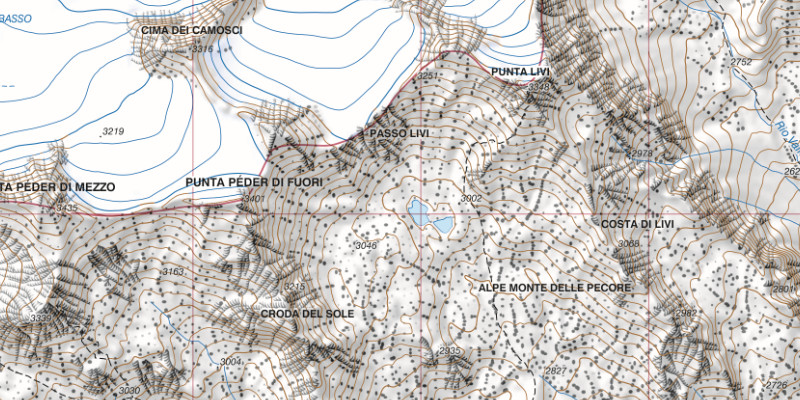
Cartographic detail with orographic data
Contents
Contents are mainly obtained from regional sources, integrated with IGMI data , other National Public Agency data, and data available on-line, such as Open Street Map data;
displayed data are the result of revisions based on orthoimagery interpretation and aren’t based on direct area surveys;
the road network is updated for major links;
administrative boundaries are derived from the cadastral ones, with adjustments to make municipal areas congruent with one another and with the State border;
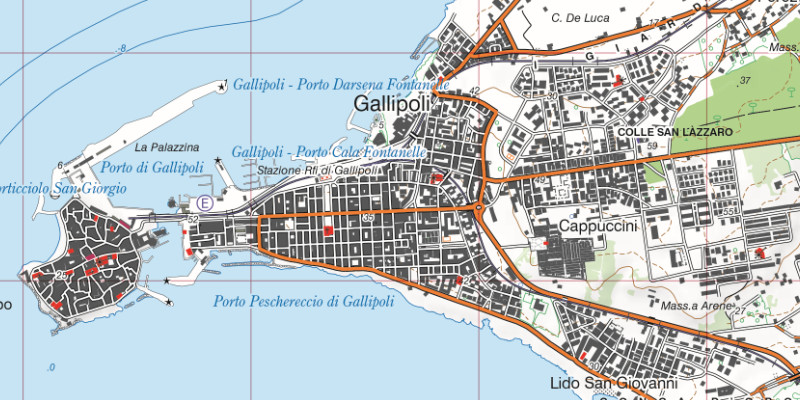
built-up areas are detailed by major land-use categories;
toponymy is currently under updating and standardization process.
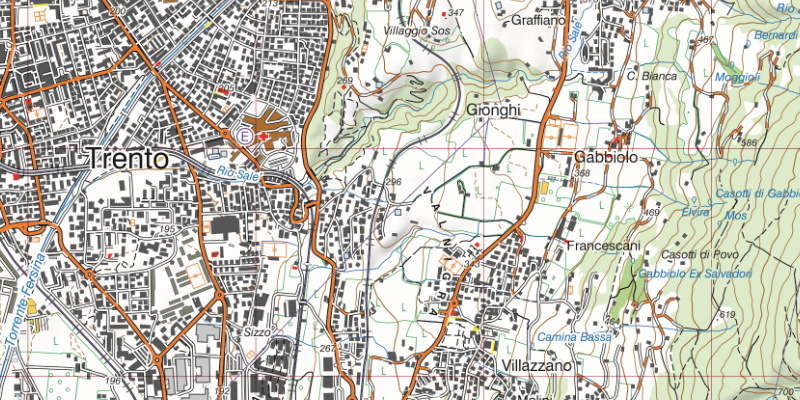
Cartographic detail of built-up area
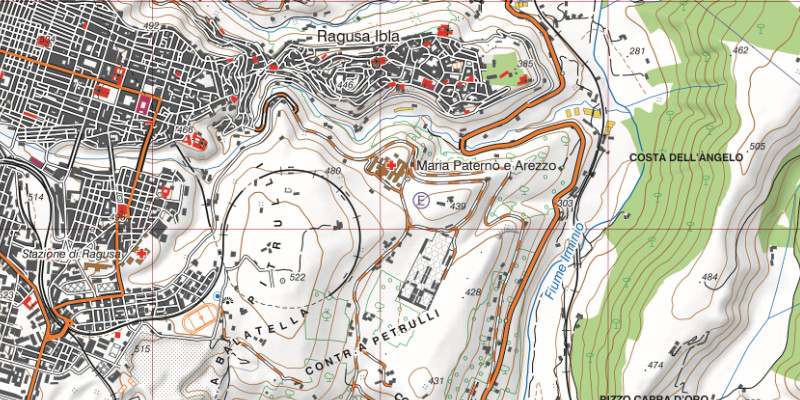
Cartographic detail with symbology indicated in different colors
Notes on symbology
Symbols used in maps at scale 1:25,000 have been deeply revised from previous series. Although the style is deeply rooted in IGMI history, some updates have been carried out according to the new objects listed in the technical specifications.
The great variety of reference data has encouraged greater differentiation in the symbols used; for example, buildings are highlighted according to their use: religious, administrative, healthcare, agricultural, commercial, industrial, military, etc.
Symbols have been revised to highlight their logical grouping. For example, in many cases the “color” classifies the object being represented: administrative components have been represented in “purple” (administrative boundaries, town halls, …), electricity-related objects in “electric blue” (power plants, power lines, transformer substations, electrified railways), sports facilities in “red” (stadiums, tennis courts, various sports tracks, etc.), landforms in “brown” (contour lines, embankments, escarpments, sinkholes, etc.), and air transport components are depicted in “aviation blue” (airports, heliports, runways, etc.).
Explore the Italian Military Geographic Institute’s aerial photo archives: more than 300,000 photograms of Italy and some foreign states, taken between 1927 and 2010.
Cartography
Discover the official cartography of Italy produced by IGMI: accurate and updated maps, all realized with state-of-the-art technologies.
Historical Maps
Discover a unique collection of historical maps, perfect for scholars, collectors and enthusiasts.
Terrestrial Photos
Thousands of historic, panoramic and terrestrial images of Italy and overseas territories, taken between 1876 and 1945
Geodetic Elements and Conversion Software
On line purchasing of high quality IGMI products.
Books and Magazines
Increase your knowledge of the territory by the Italian Military Geographic Institute’s publications.